
Hollywood celebrated this past award season, from intimate portrayals of fractured families to sweeping dramas about power, ambition, and survival. Behind the scenes, a more compelling story was unfolding, one that traced a path from Himalayan battlefields to Wall Street to some of India’s most underserved communities.
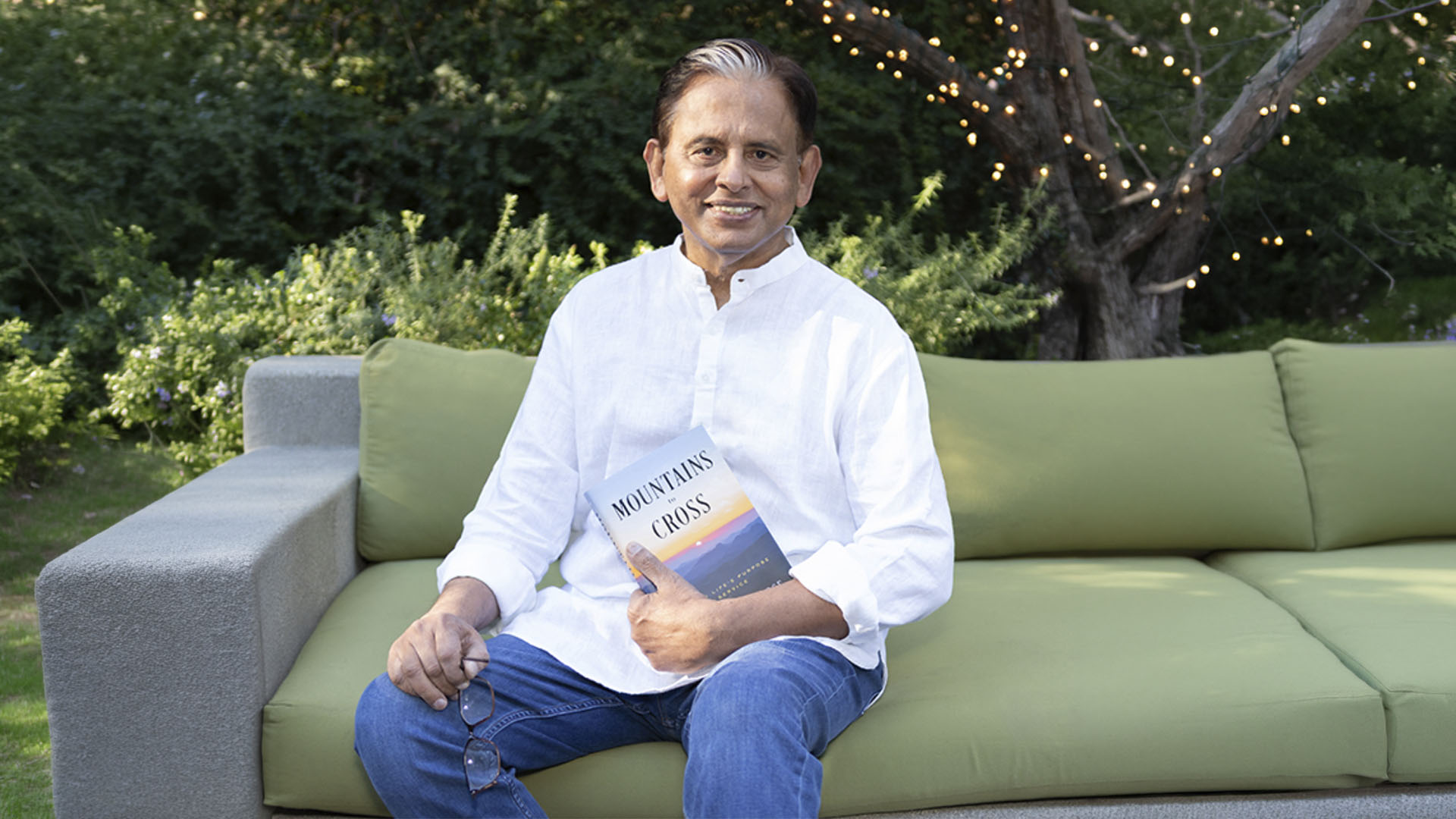
Invited to the DPA Golden Gift Suite, Dr. Abraham M. George stepped into that spotlight to engage entertainment industry leaders in a conversation about service, leadership, and responsibility. His memoir, Mountains to Cross: Finding Life’s Purpose in Service, served as both backdrop and blueprint for that discussion.
A former Indian Army officer turned social entrepreneur, Dr. George had a clear message for Hollywood’s power brokers: influence and visibility are most meaningful when paired with sustained, measurable service to those far beyond the spotlight. “Excuses and explanations for inaction do not suffice,” he says. Success carries an obligation.
That conviction anchors a life that has stretched from the Himalayan borderlands to American boardrooms and back again to India’s most marginalized communities. Over the course of his career, Dr. George has built companies, advised institutions, authored books on international corporate finance, and served on global nonprofit boards. For him, achievement is a form of leverage, and the defining question for any leader is what they choose to do with it.
A True Entrepreneur
In his early years as an artillery officer in the Indian Army stationed at the Se La Mountain Pass on the India–China border, he operated in one of the harshest terrains in the world. A near-fatal dynamite accident at eighteen sharpened his sense of mortality and purpose.
After his military career, Dr. George moved to the United States, earned two master’s degrees and a PhD in business administration from New York University, and built a successful entrepreneurial career that spanned nearly twenty-five years. He mastered the mechanics of global finance and corporate growth, achieving the financial security many executives spend decades pursuing.
By the mid-1990s, Dr. George concluded that expertise accumulated in capital markets could be redirected toward structural inequities he had witnessed growing up in India. In 1995, he stepped away from Wall Street and returned home with a plan to confront caste discrimination and entrenched poverty through institution building rather than episodic charity.
Education as a Long-Term Strategy
Back in India, he founded Shanti Bhavan, a residential school for children born into extreme poverty, built on a deliberately comprehensive model meant to encourage generational economic mobility. Students are admitted in early childhood and supported through college, receiving education, healthcare, nutrition, and sustained mentorship under one umbrella. Shanti Bhavan’s graduates have gone on to attend leading universities and enter professions that were historically closed to their families.
“Real change happens when we stop asking, ‘What more can I get?’ and start asking, ‘What more can I give?’” Dr. George says. But good intentions are insufficient without systems that endure beyond the founder’s presence. Service must be structured with the same rigor as any successful enterprise. For example, during the 2008 financial crisis, when philanthropic capital tightened globally, he applied corporate discipline to ensure students’ education continued uninterrupted.
Strengthening the Pillars of Civil Society
While education has long been regarded as one of the most powerful tools for addressing inequality, Dr. George views it as only one pillar of a functioning society. Durable progress requires credible institutions across media, healthcare, and public health. He founded the Indian Institute of Journalism and New Media to cultivate a free and independent press, and a rural hospital serving fifteen villages across Tamil Nadu and Karnataka, where limited access to healthcare can determine whether families remain trapped in poverty.
Dr. George played a key role in the nationwide removal of lead from gasoline in April 2000 and helped establish the National Referral Centre for Lead Poisoning. The campaign required coordination across policymakers, scientists, and industry leaders, underscoring his conviction that public health reform, when executed at scale, can transform millions of lives.
50–50 life
In Mountains to Cross, Dr. George introduces the concept of a “50 50 life,” encouraging individuals to divide their energy between personal advancement and service. The framework is a call for proportional responsibility. Financial success expands one’s capacity to act. The moral question is whether that capacity remains dormant.
“My book is for people who’ve achieved financial success and are now wondering how to make it matter,” Dr. George says. “It also inspires younger people who aspire for success and contribute to the world.” The audience he envisions includes executives, entrepreneurs, and emerging leaders who recognize that legacy is shaped as much by allocation as by accumulation.
Dr. George has served on boards including Human Rights Watch and the International Center for Journalists and authored books on international corporate finance alongside volumes chronicling his social initiatives. Across these roles, a consistent philosophy emerges. Institutions, when built with rigor and guided by ethical clarity, can outlast individual careers.
As the entertainment industry celebrates its highest achievers, Dr. George’s presence during awards week offered a counternarrative. Recognition is fleeting; impact, however, compounds over decades. “The path to accomplishing life’s purpose is paved with challenges,” he says, “but the journey is undoubtedly worth taking.”