
“Competence used to buy you time,” Nawbatt says. “In 2026, competence is table stakes. The market is rewarding a different set of behaviors, and many professionals are still playing by the old rules.”
Across industries, a growing number of professionals report that job security feels increasingly fragile. As the rules of work shift in plain sight, the changes are cutting through roles that once seemed insulated from disruption.
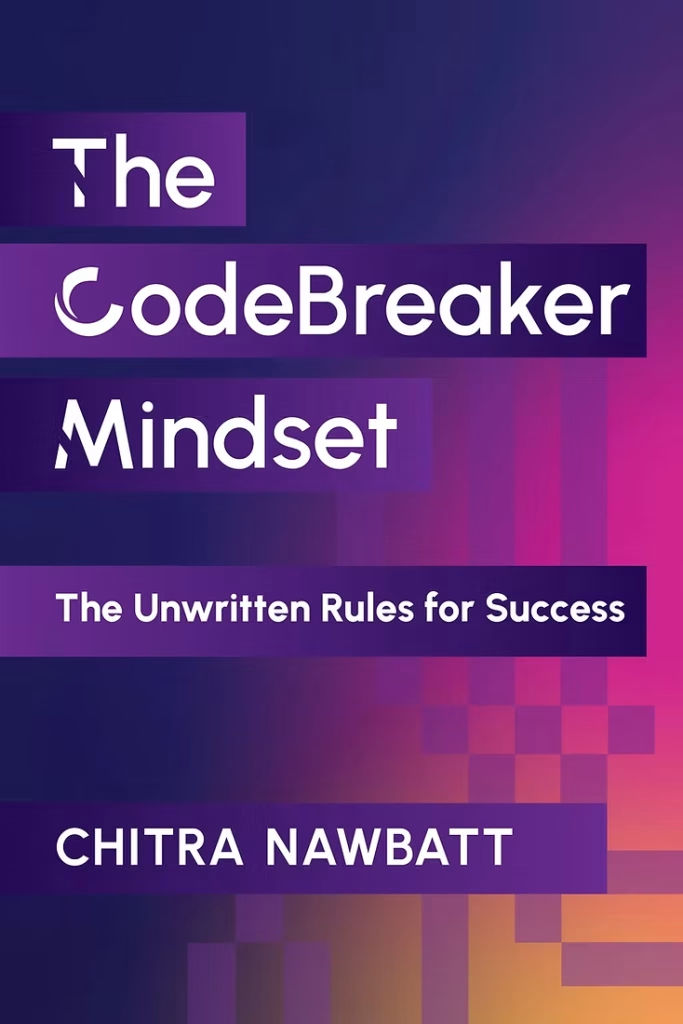
The impact isn’t limited to underperformers or redundant teams. Layoffs are now appearing in the middle of organizational charts, within core business functions, and among employees who were recently considered essential. According to strategic growth advisor Chitra Nawbatt, author of The CodeBreaker Mindset: The Unwritten Rules for Success, this signals a deeper structural change in how companies define value.
The Changing Rules of Career Survival
The more immediate force is organizational redesign. Companies are flattening decision layers, reducing bureaucracy, and repricing labor around speed and adaptability. Reuters recently reported that Amazon is preparing additional corporate job cuts as part of an effort to streamline its structure and remove management layers, even as it continues to invest selectively in priority roles tied to long-term strategy. “The narrative is convenient,” says Nawbatt. “Blaming technology masks the harder truth. Many organizations are still figuring out how to operate efficiently in a volatile environment, and people get caught in that recalibration.”
Data from HR leaders underscores the contradiction. A January 2026 survey cited by HR Dive found that nearly half of companies expect layoffs will likely occur in the first quarter, while most also plan to hire selectively for roles tied to growth initiatives. This dual track of hiring and cutting reveals why performance reviews alone no longer predict job security. The system itself is changing faster than individual output can keep up.
CodeBreakers: The New Professional
Nawbatt describes the professionals who thrive in this environment as CodeBreakers. The term does not refer to rule breakers for their own sake, but to people who understand that success is governed by both written rules and unwritten ones. “Written rules tell you how things are supposed to work,” she says. “Unwritten rules tell you how decisions actually get made when pressure hits. In periods of reorganization, the unwritten rules are what determine who stays and who goes.”
Nawbatt outlines five shifts that separate those who remain relevant from those who become interchangeable.
1. Pattern recognition: Efficiency can feel reassuring in unstable times, but it can also be misleading. “The winners are not the busiest people,” she says. “They are the ones who can see where budgets are tightening, where automation is accelerating, and where their work is becoming easier to replace.”
2. The new operating system: During restructurings, informal dynamics take over; who is protected, which narratives leadership repeats, and how risk is managed become far more important than stated policies. “When written and unwritten rules diverge,” Nawbatt says, “the people who notice early have options. Everyone else is reacting.”
3. Nonlinear value stack: In today’s environment, resilience comes from a portfolio of relevance that spans skills, relationships, and credibility across contexts. “You are not competing for a seat anymore,” Nawbatt says. “You are trying to become a node in an ecosystem. The goal is to create value that travels with you when structures change.”
4. Information quality, not quantity: The ability to distinguish data-driven insight from perception- or manipulation-driven narratives is becoming a defining leadership skill. “Clarity is power,” she says. “The person who can say what is true, what is assumed, and what is being spun becomes indispensable when decisions must be made under uncertainty.”
5. Replace ladders with loops: Career progress in 2026 is less linear and more iterative. Learning, testing, building proof, and compounding impact now matter more than waiting for titles or recognition. “High performers often get stuck waiting to be noticed,” Nawbatt says. “CodeBreakers build evidence. They create work that can be demonstrated, taught, and scaled.”
A Market That No Longer Rewards Comfort
AI will continue to improve and organizations will continue to thin. If this moment feels uncomfortable, that discomfort may be the point. The market has stopped rewarding stability for its own sake. The professionals most likely to thrive are those who confront change early and adjust with intention.
“The CodeBreaker mindset is not about fear. It is about clarity. It is about understanding how systems really work and moving with discernment when those systems shift.”
Renowned strategic growth advisor and business builder Chitra Nawbatt is a systems-level strategist known for decoding how power, careers, and leadership actually operate in the age of AI, and why traditional playbooks are quietly failing. With more than two decades spanning global media, markets, and influence, she served as a global business journalist for Reuters, BNN Bloomberg, and CCTV before pivoting from reporting on power to operating within it as a partner at General Catalyst and an advisor to Fortune 500 leaders. Her new book, The CodeBreaker Mindset: The Unwritten Rules for Success, distills her journey and insights into a practical blueprint for dismantling visible and invisible barriers to relevance, judgment, and influence. To discuss and learn more, connect at www.ChitraNawbatt.com.
Sources
https://www.hrdive.com/news/companies-hiring-and-firing-2026/809286