
The motorcycle industry has spent decades perfecting the machine and comparatively little time closing the distance between what riders know they should wear and what they actually put on before pulling out of the driveway. That distance has a name, and Stevan Popovich, who leads the store network at Cycle Gear, calls it the gear gap. It is not a knowledge problem in the usual sense. Most riders can recite the argument for protective equipment. They buy the helmet, treat that as the safety decision made, and leave the jacket, gloves, riding pants, boots, and airbag system for some future version of themselves. The gap persists because protection is still being purchased as a checklist item rather than a system, and because the single product that has done the most to reduce injury severity in professional racing over the past decade still carries the cultural scent of something meant for somebody else. Closing that gap is a behavioral project, not a product launch, and the people best positioned to run it are standing behind retail counters.
Preparing For The Slide, Not Just The Ride
Popovich frames the problem around a phrase his teams use constantly. “At Cycle Gear, we talk about preparing for the slide, not just the ride,” he explains. “You can’t predict when a crash is going to happen, so the goal is to be as prepared as possible if it does.” He reduces it to three things: be present, be protected, and follow the rules of the road. The language matters more than it first appears. Most safety messaging asks riders to imagine an accident, which is precisely the mental leap that riders are practiced at refusing. Reframing the decision around preparation rather than prediction removes the need to concede anything about one’s own skill.
The deeper issue is that partial protection feels like protection. A rider in a helmet and a casual jacket has, in their own accounting, made a responsible choice. Popovich wants the measure of progress to be different. “I’d know we’re making progress when riders start thinking about protection as a complete system, rather than checking one box for a helmet and calling it done.” That standard is harder to meet and harder to sell, because it asks riders to look at gear the way engineers look at redundancy rather than the way consumers look at features. Until the complete system becomes the default mental model, the gap stays open regardless of how good any individual product gets.
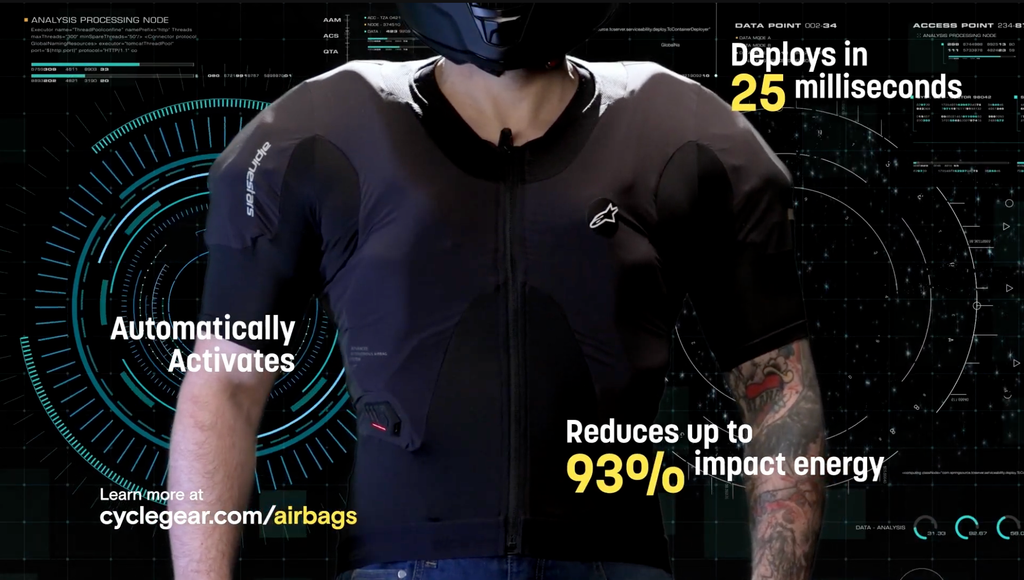
Photo Credit: Cycle Gear
What Really Moves A Rider
Electronic airbag vests now deploy in under 30 milliseconds, and the technology has been refined for years in professional racing before reaching everyday riders in more comfortable, more intuitive forms. The hardware is not what is holding adoption back. “The biggest remaining hurdle is awareness and changing behavior,” Popovich says. “A lot of riders still think about an airbag as something for a professional racer or an especially cautious rider. We need to get to the point where people see it as another normal piece of protective equipment, just like a helmet.” He does not claim the industry is there yet. He says the direction is clear.
What converts awareness into purchase is not a spec sheet. When Cycle Gear launched its Airbags Save campaign, the company found that many riders simply did not know wearable airbags existed outside the racetrack. The turning point of the conversation was a colleague’s experience. Guilherme Ortigosa, a Cycle Gear employee, was encouraged by his store manager to invest in an airbag and was in a serious crash days after buying one. He credits the airbag with protecting his upper body and walking away with only broken bones in his foot. “Guilherme’s story is much more powerful than simply telling someone that a product is innovative,” Popovich adds. That asymmetry between demonstrated outcome and marketing claim is the operating insight for anyone trying to sell protection. Riders discount assertions and weight evidence from people who ride.
The Counter As Infrastructure
There is a reason Popovich places retailers at the center of this process rather than manufacturers or regulators. “Retailers have an important role because we are where education and product meet,” he says. “We can demonstrate new technologies, answer questions, and help riders find gear that fits their needs and their riding style. We also have to make the conversation approachable. Nobody wants to be lectured about safety.” The last sentence is the one most safety campaigns ignore. Lecturing produces compliance theater at best and resentment at worst, and riders have heard every version of it.
What works instead is credibility earned sideways. Popovich staffs stores with riders because riders can tell the difference. “They’re not necessarily looking for someone to simply tell them what product to buy. They want someone who understands how they ride, what they’re comfortable with, and what problem they’re trying to solve.” That standard applies equally to which technologies get shelf space. “The first question is always: does it solve a real problem for the rider? I’m a big believer in innovation, but innovation for the sake of adding features doesn’t necessarily make a product better.” He learned the cost of getting that wrong when the company introduced self-service kiosks on the assumption that customers wanted convenience. They wanted the conversation instead. The lesson transfers directly to the gear gap: technology that removes the human from the equation removes the element that changes behavior. Popovich’s broader argument is that the industry has to stop treating safety as a specialty category and start building it into the entry point, which is why he points to efforts like Ride With Us – a nationwide initiative backed by the Motorcycle Industry Council dedicated to welcoming new riders into the motorcycle community in a safe, controlled environment. The earlier riders learn to prioritize safety, the better positioned they are to carry those habits with them throughout their riding journey and the safer the road is for all who share it.
Follow Stevan Popovich on LinkedIn for more insights on motorcycle safety technology, rider education, and specialty retail leadership.