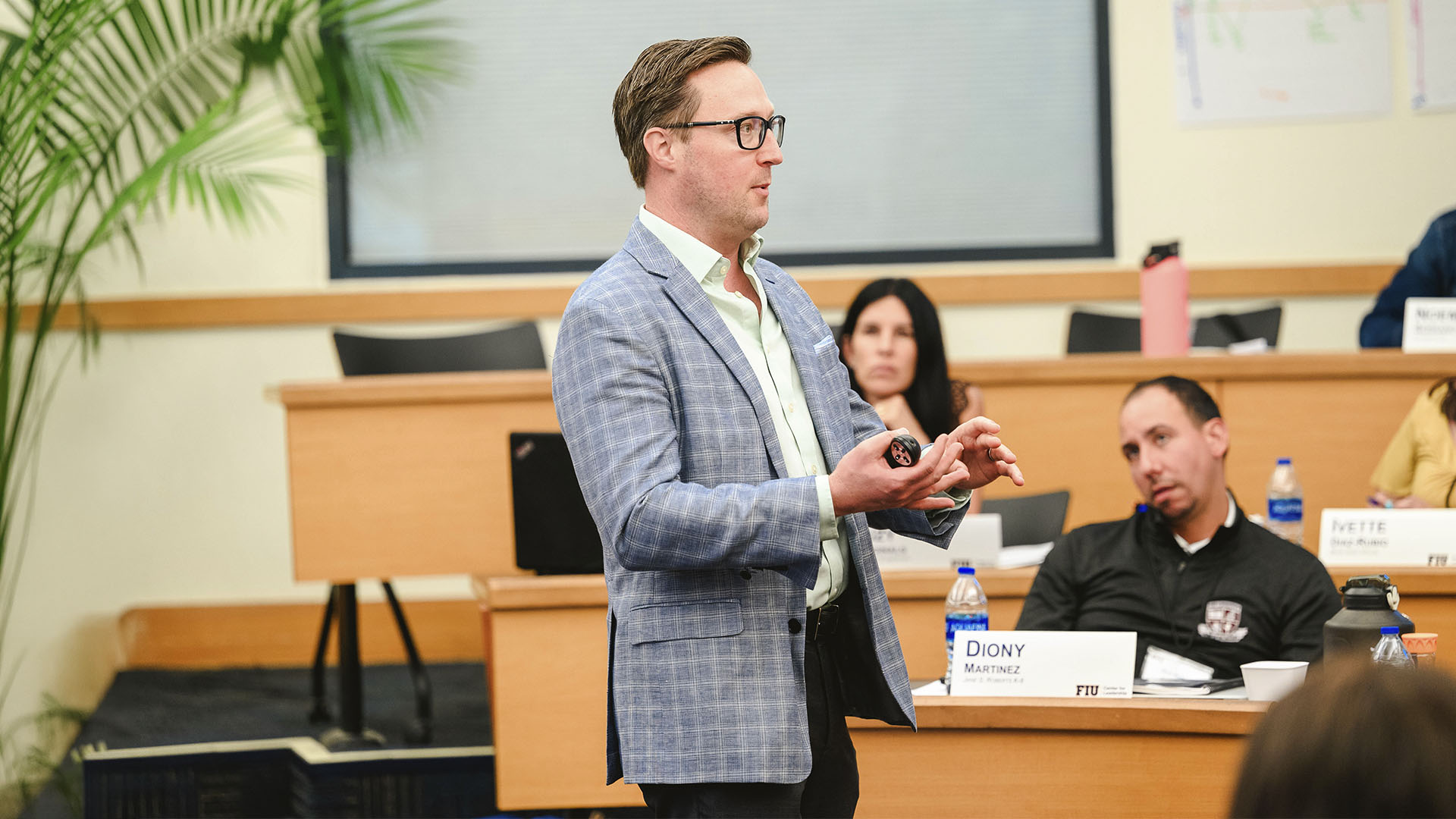

The current obsession with artificial intelligence (AI) adoption metrics is distracting leaders from the more difficult question of how technology should fundamentally reshape the way organizations create value. As organizations race to embrace AI, many mistake activity for transformation. “AI adoption isn’t the right metric. The real value comes from totally rethinking processes and how value is created within your organization,” says Nathan J. Hiller, Executive Director of the Center for Leadership and Ingersoll-Rand Professor of Management at Florida International University. While executives scramble to prove progress, many are prioritizing efficiency gains over effectiveness, leaving organizations vulnerable to faster and more agile competitors. For Hiller, succeeding in the wave of AI disruption comes down to building organizations capable of adapting without losing sight of the human systems.
Why Efficiency Alone Is Not Enough
Across industries, executives are under pressure to demonstrate measurable AI progress, and publicly celebrate adoption figures while failing to define what meaningful adoption actually looks like. “You can be highly efficient and highly ineffective,” says Hiller, pointing to healthcare as an example. The opportunity is not simply reducing administrative workload. The greater opportunity is redesigning workflows so physicians can spend more time with patients rather than typing notes into systems.
Large organizations often struggle with this shift because they are designed to protect existing business models. Hiller compares them to massive ships that cannot turn quickly, while smaller early-stage companies move like speedboats, testing ideas and capturing market share with far greater agility. “One of the essences of disruption is how do you not be afraid to destroy the thing that has added value in the pursuit of creating something new,” Hiller says.
Where Are We Heading? Anybody?
One of the greatest barriers to purposeful disruption is the disconnect between senior executives and employees. Within organizations, employees are often expected to innovate while simultaneously being restricted from using the tools that enable experimentation. ” Leaders believe that they have been clearly articulating and making a case that people can understand what the big picture is,” Hiller says. “And they have not been clear. At all.”
Fewer than 5% of senior leaders communicate strategy and direction effectively enough for employees across the organization to align around a shared understanding. This creates confusion during periods of disruption, especially when employees are already dealing with uncertainty surrounding inflation, geopolitical instability, and rapid advances in AI. “You cannot learn new things when you are scared to death for your future,” Hiller says.
Building Organizations Designed for Experimentation
Hiller argues that organizations must intentionally create structures that allow experimentation to happen without being constrained by existing bureaucracy. One of the most effective models, he says, is the concept of “skunk works” innovation teams. These protected environments give innovators and intrapreneurs the freedom to test ideas outside normal reporting structures and operational constraints. “You have to create a separate space for them and give them an opportunity to try to innovate,” Hiller says. Without those protected environments, innovators often become frustrated and disengaged long before meaningful transformation occurs.
Leaders must also become active participants in technological experimentation rather than delegating AI exploration entirely to technical teams. “Senior leaders actually need to learn how to use AI and experiment with it,” he says. Importantly, he encourages executives to begin experimenting outside their immediate business needs. Exploring AI tools casually and creatively helps leaders develop intuition about new ways of thinking before attempting organization-wide implementation.
The Next Generation of Leadership
As AI systems become more integrated into daily work, leadership responsibilities are expanding beyond formal management roles. Employees increasingly need the systems thinking, decision-making skills, and cross-functional understanding that were once reserved for senior leaders. Future workers will orchestrate networks of AI agents, monitor outputs, provide feedback, and make judgment calls across multiple domains. “Many individual employees are already having to make decisions and move at a pace that used to be the domain of formally appointed managers or leaders,” Hiller says.
That shift is creating unprecedented cognitive pressure. While some portray AI as a shortcut to reduced workloads, Hiller sees the opposite emerging among high-performing professionals. “The cognitive load on individuals is massive,” he says. Purposeful disruption ultimately depends on maintaining a learning orientation in the middle of uncertainty. Organizations that succeed will be the ones capable of balancing experimentation and human adaptability while redefining how they create value.
Follow Nathan J. Hiller on LinkedIn for more insights on purposeful disruption, leadership communication gaps, and building organizations designed for experimentation.